Non-Fatal Heart Attack
 Fatal
Heart Attack
Fatal
Heart Attack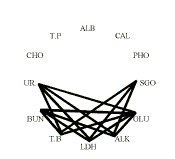
Systemic Failure to Account for Role of Reproductive Labor
of Women
Debora Hammond
Hutchins School of Liberal Studies
Sonoma State University
1801 East Cotati Ave.
Rohnert Park, CA 94928
hammond@sonoma.edu
In exploring the role of women and children in community, this
paper will focus on the systemic failure of the current economic
accounting system to recognize or to acknowledge the vital and
foundational role of reproductive labor, generally performed by
women and usually without remuneration. The unidimensional emphasis
on productivity, on maximizing the throughput of material goods
in the marketplace, has resulted in a tremendous waste of resources,
both natural and human. Ecofeminist scholars have drawn attention
to the connection between the devaluation of the reproductive
labor of women and the parallel devaluation of the regenerative
work of nature. Of course, reproductive labor must be understood
in as comprehensive a sense as possible, beyond the obvious tasks
of having babies and raising children; in the broadest sense it
encompasses all of the work involved in reproducing the conditions
of daily life: growing and preparing food; caring for the young,
old, and infirm; sustaining community relationships; and passing
on the cultural heritage to the next generation - maintaining
the household of humanity. The word economics is rooted in the
Greek work oikos, meaning household, and originally referred specifically
to the management of the household. Oikos is also the root of
ecology, the study of nature's household, in terms of the relationships
among living beings within community. The poverty of human community
in our fast-paced and commodified lives at the dawn of the twenty
first century beckons us to reexamine the economics of our collective
household and challenges us to find ways to reassign value to
those intangible dimensions of being and sharing with others that
sustain us in both material and non-material ways that are absolutely
essential to our wellbeing.
[01- 59]
SYSTEMS CRACKS ARE WHERE THE LIGHT GETS IN:
MODELS AND MEASURES OF SERVICE IN THE BENEFIT OF CONTEXT
David Hawk
School of Management
New Jersey Institute of Technology
University Heights, Newark, NJ 07040
USA
Annaleena Parhankangas
Department of Industrial Engineering and Management
Helsinki University of Technology
PO Box 9500
02015 HUT, FINLAND
A paradox is emerging for those concerned about management theory
and practice. The paradox lies with the activities and products
of organizations becoming more fluid while organizational structure
and management models remained fixed. Managerial emphasis favor
the more "solid" aspects of organizations while their
leading edges become more "fluid." Management lore and
principles continue to be taught, and practiced, as if what remains
was timeless. Management continues to base its decision-making
on information from statistical and reductionistic analysis. The
result is a noteworthy mismatch between the rate of change in
the environmental and the human desire for constancy. The mismatch
is showing up on the surface of situations in what we herein called
"cracks." Cracks can also be seen in the surfaces of
organizations, products and customer bases.
The theory behind the paper comes from the early 1940s. Cracks
point to system forces that were not been reconciled within the
limits of the system. "Crackage" may also be a sign
of systems reaching their limits. Herein the systems of interest
are social organizations and their management. The main interest
thus becomes management theory, where cracks appear where a principle
appears inadequate, even humorous, in the face of an organizational
challenge. Such cracks are more obvious with time. Using command
and control strategies to manage internet information access and
use is one example. Such cracks can be seen as early indicators
of larger problems looming for organizations. This point was at
the center of a discussion held in the business systems special
interest group session of last year"s ISSS Conference. It
was argued that radically different forms and norms of management
were needed. One metaphor proposed from that discussion was to
find more "fluid" methods of management for dealing
with increasingly fluid entities and environments. This idea is
used herein to describe one of the major events now taking place
in economic and business systems, the transformation from goods
to services. The shift from solid to fluid processes and products
is clearly seen in the emergence of the importance of services.
An alternative software operating system, called Linux, is presented
as a leading example of why this change is different and fundamental.
Linux provides a doorway into an alternative model of business
management. Linux illustrating an interesting progression from
problems in solids that are manageable, but tend to crack, to
fluids that don"t crack but tend to be beyond understanding
and management.
Key words: Change, Structural Cracks, New Services, New Business
Values, Linux OS
Negotiating With Our Future Cultures
David Hawk, Professor
School of Management, New Jersey Institute of Technology,
University Heights, Newark, New Jersey, 07040, USA
e-mail hawkd@ADM.njit.edu.com
Satu Teerikangas,
Department of Industrial Engineering and Management,
Helsinki University of Technology, P.O. Box 9500, FIN-02015 HUT,
Finland
e-mail: STEERI@tuta.hut.fi
Our paper begins and ends with an enduring constant of social
systems – "culture." Culture has provided a baseline
context for individuals to belong to larger social systems, as
well as bulwark against change in human affairs. Culture has become
a basis for defining what becomes institutionalized, and how it
is to do things that will be perceived as an institution. In the
modern world a form of culture known as corporate cultire has
become quite important to what we do and who we are. It has become
a center-piece for the economic continuity of many social groups
and most socio-economic activity. Yet, somehow corporate culture
has come to define culture in ways that benefit only some parts
of a society at the expense of other parts. In this way culture
serves to formalize (to fix) human relations in ways that are
against the potentials of the informal (the dynamic). Culture
is normally defined so as to give historical meaning of human
affairs, but such forms of meaning can be as constraining as they
are comforting.
We propose a expanded and reorganized redefinition of culture
so as to use the potential in its continuous mirror image to renegotiate
human futures. We propose to systemically unfix its sense of permanence,
to throw culture into the future as a feed-forward instrument
that links future aspirations to present activity. The traditional
image of culture as only a feedback mechanism, to remind people
of whether they are inside or outside of a cultural group, is
stood on its head as a means to bring normative values out from
the future. This may all seem conceptually difficult. It is in
fact a rather straightforward means to use ideas of the future
to direct activities of the present. Herein we pursue this idea
via the social systems situation of mergers and acquisitions between
two corporate cultures. Examining this context allows us to understand
the importance of culture, organizational culture, corporate culture,
and how corporate culture can be managed to the benefit of its
host as well as context.
Keywords: Culture, change, changelessness, feedback, feedforward,
social systems, futures
[01- 91]
The Universe - And Beyond:
The Birth Of The Universe(Out Of Infinity)And Its Death(Return
To
Infinity)
Daniel Hershey
Professor of Chemical Engineering
University of Cincinnati
Cincinnati,Ohio 45221-0171 USA
E-Mail:Daniel.Hershey@UC.EDU
Web:www.basaltech.com
After presenting a short history of the current theories governing the evolution of the universe,I will introduce the concept of Infinity and show with calculations how the universe may have been formed from Infinity by a self-organizing process,and will return to its origins in Infinity.I will show calculated values for the pressure,temperature,volume,and entropy of the universe as it evolves from birth to death.
[01- 6]
A Table Of Organization For The World's Nations
Daniel Hershey
Professor of Chemical Engineering
University of Cincinnati
Cincinnati,Ohio 45221-0171 USA
E-Mail:Daniel.Hershey@UC.EDU
Web:www.basaltech.com
I will present parameters which define the power of countries and their levels in the hierarchy of the world. The geometry of this world structure will be analyzed, as well as interactions between nations ,the center of gravity and symmetry of power distribution, and Shannon's informational entropy content. We will also show how to determine the "boss" relationships for these nations ,i.e., which one most strongly influences another.
[01- 6]
A Critique Of Current Pedagogical Approaches To The Education Of Information Systems Practitioners And Proposals For An Improved, Human-Centric Curriculum
Hopkins, J.B.
Anglia Polytechnic University
School of Design and Communication Systems
Bishop Hall Lane
Chelmsford, CM1 1SQ
UK
Email: gwentman@hotmail.com or j.b.hopkins@anglia.ac.uk
The paper addresses the continuing problematical issue within information systems (IS) development concerning the respective roles, rights and responsibilities of the various stakeholders in this process. In particular, it focuses on the problems arising from what is still perceived as a 'conflict of cultures' between the technical developers and the users/clients of such systems. This micro-scenario also needs to be placed in the wider social context of a world where such systems are regarded as being of ever-increasing importance and service to the various communities to which they are intended to contribute. As such these information systems are assuming roles well beyond their original perceived (and conceived) boundaries, which often seemed to be drawn within organisations with relatively little regard for their wider social impact. In these circumstances IS practitioners and academics surely have an obligation to reflect upon their practices.
The findings and proposals contained in the paper result from 25 years of experience on the part of the author in the teaching of IS development in the UK (following 15 years as a practitioner and consultant in the IS field) and his doctoral research in this field over the last 5 years. In summary the findings depict a pedagogical mindset grounded in a positivist, techno-functionalist view of the world in which the human and social aspects are at best relegated to a secondary position, and where the approaches so successfully applied in the field of engineering have been transposed (with mixed results) to human-activity systems.
The outline proposals for improvement centre on a curriculum which seeks to achieve a judicious and appropriate blend of these two major streams, based on the premise that, in order to achieve success in this area, all of the partners with an interest in the successful implementation of an IS must have a real opportunity to influence its design and operation. Also described are some experiments conducted with student groups to assess the feasibility and potential of the proposed different approaches.
Some "trigger" questions
1. Should the design of information systems be the province
primarily of the technical 'expert'"
2. Should our education of IS practitioners privilege this same
mindset"
3. Are there more appropriate pedagogical avenues than the techno-functionalist
one"
4. How do we induce IS practitioners and educators to take genuine
account of human and social factors"
Information Systems As Enablers Of A Managerial Revolution" A Critical Appraisal Of Their Potential As Agents In This Process
Hopkins, J. B.
Anglia Polytechnic University
School of Design and Communication Systems
Bishop Hall Lane
Chelmsford, CM1 1SQ
UK
Email: gwentman@hotmail.com or j.b.hopkins@anglia.ac.uk
At intervals over the past four decades computers and information technology (IT) have been heralded as the standard bearers of revolutionary changes in the methods and techniques that we use to achieve our goals both organisationally and, increasingly, socially. There is considerable evidence to support the assertion that we have lived through momentous technological changes in this field but it is much more hazardous to argue that equivalent changes have occurred over that period in the ways that we have applied these exciting developments. In fact, there are some observers who would argue that we have demonstrated a lack of imagination, sympathy and creativity in our organisational and social implementations of IT.
This paper takes these contrasting (and in some cases, complementary) schools of thought as its starting point, reviews the evidence for and against them and draws conclusions which aim to provide a grounded, substantiated base from which to implement a programme of education, development and implementation with regard to IT which truly and realistically aspires to the goals implied in the title of the paper.
The review of the evidence traces the historical development of the concepts and philosophies which have influenced thinking and practice within the IT community over four decades of implementation. It covers both the growth within the IT community of initiatives to refine methods and techniques and the parallel series of approaches to management problem-solving. In the earlier days, the parallel approaches in the IT field and in management practice remained largely separate, with each party either unaware of, or uninterested in, the development activities of the other. In later years there has been an element of convergence as the parties achieved mutual recognition of ways in which they could assist each other. However, the outcomes of that recognition of a combination of interests have not been uniformly positive.
The paper asks, and attempts to answer, the questions: Why should this state of affairs have been so persistent" What is the real role of the IT community in organisational information processing" What are the most effective ways for the IT community to contribute to the building of an information infrastructure within organisations" The answers centre on an assertion that the IT community has its philosophical and practical roots in the field of engineering and that this inheritance has brought a legacy of thought which is, to a large extent (and too frequently), inimical to, and incompatible with, that of the practising manager.
Developing this theme the paper argues that before the IT community
can claim to be in a position to make any profound and meaningful
contribution to changes in management outlook there is a need
for an honest, reflective self-analysis of its fundamental attitudes
and thinking together with the ways in which these are translated
into practice. From the foundation of such an appraisal it should
then be possible to devise and deliver a programme for change
involving all stakeholders in the critically important processes
of information systems design. [01- 69]
Serving Humanity: Utilizing a Post-formal Method in the Analysis of Human Activity Systems
Raymond A. Horn, Jr., Ph.D
Stephen F. Austin State University
Nacogdoches, Texas.
The two parts of the paper will describe post-formal inquiry
methodology and will discuss how this method could be used in
3 specific systems design models.
The description of post-formal inquiry methodology will start
with an explanation of post-formalism that will be followed by
2 examples of its use in research projects. The projects included
a post-formal inquiry into the development of an educational leadership
doctoral program, and a post-formal method utilized by principal
certification students in an action research practical inquiry
project. Finally, the benefits of using a post-formal method in
the analysis of human activity systems will be discussed. Generally,
these benefits include the following:
· A post-formal method utilizes multiple inquiry methods
that guarantee the development of multiple perspectives of the
research object.
· A post-formal method facilitates the development and
use of Banathy's 3 models used to develop a systems view.
· A post-formal method humanizes the analysis process by
including the critical components of social justice and caring.
· A post-formal method facilitates the discernment of implicate
patterns of behavior and thinking.
A discussion will explore how a post-formal methodology would
facilitate the goals and effectiveness of the following systems
design models.
· Opportunity Initiated Systems Design: Squire, K. D. (1999).
Opportunity initiated systems design. Systemic Practice and Action
Research, 12(6), 633-648.
· A Guidance System for Designing New K-12 Educational
Systems: Jenlink, P. M., & Reigeluth, C. (2000, July). A guidance
system for designing new K-12 educational systems. Paper presented
at the meeting of the International Society of Systems Science,
Toronto, Canada.
· Idealized Systems Design: Banathy, B. H. (1992). A systems
view of education: Concepts and principles for effective practice.
Englewood Cliffs, NJ: Educational Technology Publications.
Relevance to conference theme. The very nature of a post-formal
method assures the unity or integration of reflection and action.
Also in relation to service, the potential for "surprise
of self recognition" is enhanced by the broadness and depth
of understanding that occurs in a post-formal method.
[01-019]
Discourse Ethics In The Design Of Educational Systems: Considerations For Design Praxis In The Service Of Humanity
Jenlink, P.M.
Stephen F. Austin State University
Department of Secondary Education and Educational Leadership
P.O. Box 13018-SFA
Nacogdoches, TX 75962-3018
E-mail: pjenlink@sfasu.edu
This paper explores the importance of discourse ethics in the
design of educational systems, situating ethicality within the
conversational nature of social systems design (Banathy 1996).
The ethics of discourse, as related to creating new human activity
systems that are educative in purpose, becomes a primary factor
in the design decisions that guide the systems design processes.
Considerations for what is ethical as well as determining whose
ethics guide the design of a human activity system are questions
that must be addressed. The ethicality of social systems design
figures largely in the design of an educational system, particularly
when systems design is concerned with transcending existing systems
(Banathy, 1996).
This transcendence may be understood as a liberating process,
seeking to release humanity from existing societal structures
and cultural patterns that are oppressive and which seek to disadvantage
some while privileging others.
In consideration of discourse ethics in designing educational system, the introduction of reflection and critical consciousness is crucial. Design practitioners who engage in reflection and critical consciousness as integral to the design process will manifest, as a design praxis, criticality and ethicality in their actions. Praxis is a state in which one engages critically, reflectively and intentionally in an inquiry that belongs intrinsically to a project of self-understanding. Equally important, praxis seeks to understand the human condition of society. Praxis is a dialectal formative mode of ethical being which aims at understanding what it means to be a human being given the historical circumstances of political, social, psychological and societal conditioning. To engage in the design of a human activity system such as a school or educational system requires that those individuals designing the system engage in a design praxis that enables the designers (and therein the process) to realize the individual and social "self" through authentic engagements.
[01- 78]
The Pragmatics Of Educational Systems Design: Considerations For The Human Condition
Jenlink, P.M.
Stephen F. Austin State University
Department of Secondary Education and Educational Leadership
P.O. Box 13018-SFA
Nacogdoches, TX 75962-3018
Phone: (409) 468-2908
E-mail: pjenlink@sfasu.edu
This paper critically examines educational systems design through the lens of pragmaticism. Following the historical work of Charles Sanders Peirece, John Dewey, and William James, and the contemporary work of Cleo Cherryholmes, pragmaticism is concerned with the practical consequences that cam be conceivably imagined from the deliberate, self-controlled conduct of actions and activities. Examining educational systems design through a lens of pragmaticism draws to the foreground issues related to Banathy's (1996) advocacy of idealized systems design for social systems. The tensions between an idealized educational system and the pragmatics of realizing the implementation of an ideal design generate important questions for those designing the system. Importantly, pragmaticism requires that the design practitioner interpret each notion and idea by tracing its respective practical consequences. What difference would it practically make to any one if the notion or idea, rather than alternatives were selected" Given the focus of social systems design on the "ideal," pragmaticism requires that each design idea be critically examine in the context of implementation, and that the ideal be considered in relation to the individual and society for which it is designed.
A critical examination of educational systems design necessarily requires a focus on the inquiry-oriented nature of systems design, including the inquiry and discourse methods as well as the decisioning processes. Important considerations in the pragmatics of design include: conceivable consequences of design, politics of difference, anti-essentialism and anti-foundationalism as related to design, the contextual nature of design, fallabilistic inductive nature of design, importance of community and social inclusion in design, democratic nature of design, and choice of our society and way of life.
The power of systems design lies in the ability to pragmatically
consider the ideal in relation to the world, recognizing that
the consequences of actions must be a mediating factor in bringing
the designer(s) into a dialogical relationship with the system
being designed and in creating a system which contributes to the
betterment of the human condition.
[01- 79]
Intellligence At Higher Levels Of Living Systems
M. A. Kalaidjieva
Institute of Control and Systems Research
Bulgarian Academy of Science, 1113 Sofia, Bulgaria
G. A. Swanson
(corresponding author)
Tennessee Technological University, Cookeville, TN U.S.A.
Kalaidjieva's (1999) seven levels of complexity of intelligence are discussed in the context of living systems theory (LST) (Miller, 1978; Swanson & Miller, 2001). The levels of intelligence are defined on the concept of decision making within a perceptual-motor arch (a sense-response construct). The discussion focuses on the increasing complexity of intelligence as life progresses to higher levels. The evolution of life from the relatively simply to the more complex underlies the advancing technology of the current information age, and, indeed, systems thinking itself. An important element of modern information technology is the historical and continuing development of money-information. The discussion identifies important aspects of decision making that distinguish each higher level of complex intelligence, moving through biological, psychological, and sociological senses. The place and importance of money-information in modern sociological intelligence is examined.
Keywords: Intelligence, Money, Living Systems Theory, General Hierarchy, decision-making
[01-121]
Adaptive Systems View of Organizational Functions
Roberto R. Kampfner
Computer and Information science Department
College of Engineering and Computer Science
The University of Michigan-Dearborn
Dearborn, Michigan 48128
The view of organizational functions as the means by which organizational goals can be achieved helps to focus the development of information systems on the support of specific organizational functions. Usually, however, organizations need to achieve their goals in the presence of an uncertain environment. This means that, in order to survive, organizations need to change the way they function in order to be able to cope with changes in their environment. This usually brings about changes on the way their functions are set up or in the way they are performed. Due to the introduction of new or different kinds of information technology, the development of computer-based information systems is another important source of changes on the way in which organizational functions are implemented.
Obviously, the evaluation of the impact of these changes on the ability of the organization to achieve a particular set of goals is of critical importance. The distinction between the concept of organizational function as defined by the goals that it pursues and that of organizational unit that realizes the function defined in terms of the processes that implement the function is essential to this evaluation. This paper shows that the focus on functions, rather than just on the processes implementing them has advantages for the evaluation of the effect of new information technology, especially from the point of view of its effect on adaptability.
[01-117]
System Models as a Means of Identifying and Describing Organizational Information Needs and Information System Requirements
Roberto R. Kampfner
Computer and Information science Department
College of Engineering and Computer Science
The University of Michigan-Dearborn
Dearborn, Michigan 48128
The ability of models to convey information about selected aspects of systems can be used to bridge the gap between the world of the organization and the world of computer and information technology. The abstraction-synthesis methodology of information systems development (ASM) uses the organizational control systems modeling approach (OCSM) to describe the structure of organizations in a manner that facilitates the analysis and description of organizational functions and their information needs. It also uses the logical information processing structure (LIPS) formalism for the analysis and description of the computational structure underlying a particular organizational function.
The OCSM greatly facilitates the communication between people in the organization and systems analysts so that the information needs of the organization can be identified and described in an effective manner. Once the information needs have been described, the computations needed to perform the functions of the organization can in turn be identified and described with the help of the LIPS formalism. The LIPS description further facilitates the communication between systems analysts and designers.
This paper shows how the use of the modeling formalisms mentioned above permits the convergence of knowledge about the organization and knowledge about the use of computer and information technology. This in turn makes the development of information systems that effectively support organizational functions possible. The alternative is to build information systems without sufficient knowledge of the needs of the organizational functions to be supported, or without knowledge of the capabilities and use of computer and information technology.
[01-118]
Dissipation and Replication: Relating Life and Non-Life
using Precise
Analogy
David M. Keirsey
The concept of the phenomenon of a dissipative structure has become an extremely useful concept in explaining how the world works. It appears that entities such as mankind, life, the earth, the solar system, the Milky way, and our universe are examples of this phenomenon. On the other hand, Darwin's theory of evolution, revolving around the idea of replication, has also achieved some wide applicability within the realm of "life", but needs to be generalized and extended to the processes of replication of "non-life," such as, the massive dissipative structures of star systems and galaxies. This points to the need to integrate the notions of dissipation and replication in a more uniform manner.
I will suggest a methodology in the form of a game: a method
of rigorous analysis and synthesis of logical models attached
with ambiguous words that try to mirror natural systems. It is
a form of precise analogy. This will help in the comparsion of
massive dissipative/replicative structures: such as the Milky
Way, the Solar System, Earth, Gaia, Hypersea, and the Internet.
The methodology tries to avoid Newton's, Hegel's and Hilbert's
mistakes. That is, their mistake of relying too
much on either "syntax" or "semantics". The
game is a building of abstract functional relations attached to
"meaning": in other words: English words. The building
of the abstract relations is based on a mixing of a special kind
of category theory with attached computational constructs, integer
and unique word assignment. All constructs are related to each
other, and the notion of explicit and implicit context is used
to disambiguate meaning and relate particular perspectives to
models of the world.
[01- 81]
Communication In Distributed System
Using Microkernels
Ebrahim Khosravi
Computer Science Department
Southern University
Baton Rouge, LA 70813
khosravi@mail.cmps.subr.edu
Accomplishing communication in a real time is always a concern.
The users do not want to wait a long time to send a message or
gain access to a resource. A Distributed Operating System that
uses microkernels has a slow message speed. This slow speed is
caused by data conversions associated with message passing. A
Distributed Operating System that uses microkernels provide only
minimal facilities causing large context switching, thus lowering
throughput.
This paper discusses that efficiently increase throughput by using
the microkernel. Also
how to ensure during interprocess communication that a message
sent to a migrating process reaches its destination without retransmission.
Keyword: microkernls, Distributed Operating system, transparency, MkLinux, mailbox, Unbounded-Capacity buffer
[01-106]
INTERNET-ENABLED EDUCATION:
A PARADIGM FOR UNIVERSAL EDUCATION
Russell C. Kick
National University
San Diego, CA 92108
rkick@nu.edu
"Everyone has a right to education."
United Nations Universal Declaration of Human Rights, Article
26
According to the United Nations there are almost one billion people in the world who are illiterate. A major reason for this is that educational resources are more unevenly and unfairly distributed across the world than financial resources (Ryan, 1996). Because of this inequity close to a thousand million people are excluded from the opportunity for an education and condemned to a life of ignorance and despair (The International Consultative Forum on Education for All, 1996).
No one should be denied access to education because of his or her birth that determines locale and economic situation. Today equal opportunity to education simply does not exist in this world or even in the United States. Education is fundamental to the securing of rights such as quality life, liberty and the pursuit of happiness. A serious initiative toward Universal Education is necessary if humanity is to evolve to a higher level. Internet-enabled education has the potential to bring knowledge and learning to anyone on Earth, any place at any time
Keywords Internet, E-Education, Cyberspace, knowledge, education
Strategic Implications of Wireless Communications:
E-Business Information and Knowledge Systems
Russell C. Kick
National University
San Diego, California
David Copenhaver
Lucent Technologies
San Diego, California
Daniel Thomas
Silicon Square Consultants
San Diego, California
Trish Daly
University of California, San Diego
San Diego, California
Technology is no longer an afterthought in forming business strategy, but the actual cause and driver. This may well be the first rule of Internet-enabled business, and the key mission critical technology is rapidly becoming wireless communications. Wireless communications will change the business model in a major way and firms who can harness its potential and power will be able to create superior information and knowledge systems enabling them to gain and sustain strategic competitive advantage.
Wireless communications is the great source of new economic wealth providing the underlying network for capturing and processing data, the raw material for information and knowledge, the new economic wealth. Properly deployed wireless communications collects data and transmits them into a software refinement process which yields information and knowledge which is then stored and made accessible when needed. Network connectivity, and the associated information and knowledge sharing, soon will become the key revenue driver and source of enhanced business profit. Maximizing the value of the communications network, basically the Internet, thus becomes the fundamental corporate strategy.
The purpose of this paper is to present the next generation of E-Business information and knowledge systems and their strategic significance. The paper seeks to demonstrate that wireless communications is the next step in an inevitable evolutionary process underlying human communications. The evolution of communication is graphically depicted in the form of a Wireless Intelligence Revolution Model (WIRM) to show the power and inevitability of large-scale wireless communications. E-Business Information and knowledge systems rooted in wireless communications will be those that enable firms employing them to prosper and grow in the global digital economy.
Digital Age knowledge workers and management are becoming increasingly dependent on networked information, knowledge and communications resources. They want and need the connectivity which yields information and knowledge anywhere and anytime. The most successful firms in the next decade will be those that understand the meaning of wireless communications and have harnessed its power and potential. On the other hand, those firms who fail to comprehend the next phase of e-transformation, the changing paradigm of business engendered by the implementation of wireless communications, will suffer serious opportunity costs. Indeed, firms unwilling or unable to integrate wireless communications into their information and knowledge systems may well cease to exist.
[01-116]
John Jay Kineman
An epistemological study of conceptual roots for the "Gaia hypothesis" (Kineman, 1991) led to development of a new theory of "autevolution" (Kineman, 1997) with direct bearing on the definition and meaning of life. The foundations of this view were first developed with regard to evolution (Kineman, 1991), after which implications were extended to physics and cosmology (Kineman, 2000a, b). The world view is based on the assumption of "form-function complementarity" as a natural principle. Applied to evolution, this view suggests a firm basis for the Baldwin effect, resulting in meaningful evolutionary pathways. Applied to space-time physics and cosmology, this view suggests a duality of time scales between infinite "experiential time" and finite "observational time," and predicts the precise variation in the Hubble relation for an accelerating universe. The assumptions of autevolution therefore allow biology to inform physics, a paradigm reversal envisioned by Robert Rosen (Rosen, 1991, 1999). Furthermore, the fundamental explanatory power of the theory's "form-function complementarity" (which is directly analogous with Rosen's "modeling relation"), suggests this as an ontological principle of life or living. This replaces the recent Century's assumption that living systems emerged from physical systems, and suggests a "living" universe from which physical reality emerged. In this perspective, nature is structured on a primordial relationship that is fundamentally responsible for all manifestations of life. This highly parsimonious explanation of life eliminates the enigma that has surrounded the question of "emergence" and suggests further that life itself is associated with consciousness.
This view leads to the question: Is nature alive, and in what way is it alive? My answer is "yes," as Eastern traditions have claimed for centuries; and life is creative moment-to-moment, through the act of perception. We can also say why there is life: It is because the universe and all it contains is constructed through the process of functional realization, which self-organizes. In contrast, mechanical theory attempts to define life in terms of its form or behavior, and thus excludes anything that could be of essence to life, and thus any causal role for life, from the theory structure itself. From that view, a mysterious source for life must be added in order for science to account for experience. This is a dualistic view that disembodies life and thus fatally complicates its explanation. It can be shown that our deepest principles of epistemology actually support the opposite paradigm.
By structuring theory with life as a universal property, our view of the living world becomes one of creative expression, constrained (not produced) by circumstances. The material world is explainable as a "special case" of the living, where function and realization are equivalent. Where they are not, which is the fundamental case, we have life. In short, it is far easier to explain physical nature in a living universe than it is to explain life in a dead one.
[01-129]
Lezlie Kinyon
636 58th st #7
Oakland, Ca 94609
lezliek@hotmail.com
is all the hand that serves the brain can do.
The best of artists hath no thought to show
which rough stone in its superfluous shell
doth not include; to break the marble spell
(Michelangelo)
This paper represents the beginning of the exploration of an
idea: Aesthetic Inquiry, a term coined by Ruth Richards in her
1996 paper "Subtle Attraction". This paper is an attempt
to present a holistic approach to Human Science research proposing
that the arts, in terms of inquiry and discipline, are akin to
the work of human science researchers.
To do this, I will discuss the idea of "what is inquiry?"
in both human science and in art. I will explore some writers
and ideas ranging from science philosophy to art criticism and
propose the work of Ursula LeGuin and the French existentialist
writers as examples of aesthetic inquiry.
To further explore this idea I will discuss the Renaissance painters who asked questions concerning perspective in their work. This paper continues with Matisse, who found a very different answer to the same question. It then will address Kant's Critique of Judgement and the idea of beauty and disinterest, as Dr. Richards discuses a possible refutation of Kant's widely held belief that "there can be no objective rule of taste, no rule of taste that determines by concepts what is beautiful" (1790/1987).
In conclusion, I will explore the idea of kratophany and the sublime within the context of two examples of the process of the artist and the artist's purpose. This will be done with the idea of aesthetic inquiry as a way (in the Zen sense of the word) of encounter (as Rollo May used the term) which induces the researcher/artist to say: "notice this: there is something more here."
Keywords: Inquiry, Aesthetics, Art as Inquiry
[01-127]
Hisako M. Koizumi
Department of Psychiatry
The Ohio State University
Columbus, Ohio 43210
Fax: 614-451-0645
Email: HisKoizumi@aol.com
Eastern medicine, reflecting the Eastern philosophical tradition which regards the individual as a microcosm existing in a macrocosm, namely, the universe, defines health as a state of balance in the process of the individual's adaptation to the ever changing environment, a state of balance between the individual's internal defense mechanism and the external factors in the environment. In other words, health in Eastern medicine is a state of homeostatic equilibrium of the individual seen as an open system.
Reflecting such a holistic and systemic conception of health, Eastern medicine relies on a number of important principles that are very different from those employed in Western medicine. Unlike the Cartesian dualism that characterizes modern Western medicine, Eastern medicine considers mind and body as inseparable entities whose balance is an integral part of health of the individual. Maintaining health as a state of balance is facilitated by the complementary factors of yin and yang. Having evolved out of the Chinese philosophical tradition, the yin-yang complementary plays an important part in that maintaining these opposing yet interdependent factors holds a key to maintaining equilibrium within and around the body, namely, the body's organs and their functions as well as their relationship to the environment. One of the factors that lead to the breakdown of the yin-yang balance is psychological/emotional disturbance. Excessive anger, for example, is known to cause the dysfunction of liver, and vice versa. The yin-yang balance is thus closely tied up with the mind-body complementarity in maintaining health. Traditional Chinese medicine has developed two other important concepts in maintaining health--the vital energy called qi and the meridian system. The vital energy qi circulates in the meridian system, which is an invisible, circulatory system of the body that is linked to the outside world through the acupuncture points. A state of imbalance in qi-energy--excessive or deficient, blockage or stagnation of flow--would lead to a pathological state of the individual.
This paper illustrates how these principles of Eastern medicine are applied in the practice of acupuncture treatment called the Hokushinkai School in contemporary Japan. In the Hokushinkai School, the initial interview is a crucial diagnostic procedure, taking up to 90 minutes, and includes personal history, symptoms, remedial as well as adversary factors, and family history. Based on the information obtained in the interview, a hypothesis is formulated as to the condition of the patient.
The initial interview is followed by the physical examination, which includes the examination of color of body, tongue, and nails. The pulse examination is also one of the most important diagnostic procedures. These are followed by the palpation of the whole body, including the examination of the status of major acupuncture points of the meridian system. The qi energy levels of these points subjectively measured by an acupuncturist are also employed in deciding the length and force of acupuncture treatment.
The initial hypothesis may be supported by the physical examination or may be altered, depending on the findings. The therapeutic acupuncture points will then be determined. The temperature, humidity, the season, and the phase of the moon are also considered in determining the depth, the force and the length of the acupuncture treatment.
The Hokushinkai School thus employs principles of Eastern medicine such as mind-body complementairy, yin-yang balance, and qi-energy in the meridian system in both the diagnosis and treatment of the patient. The paper further illustrates how the Hokushinkai School practices Eastern medicine as a systems science with a number of concrete cases.
[01- 20]
The Buddha's Thought And Systems Science
Tetsunori Koizumi
Faculty of Intercultural Communication
Ryukoku University
1-5 Yokotani, Seta Oe-cho
Otsu-shi, Shiga 520-2194
Japan
Email: koizumi@world.ryukoku.ac.jp
The Buddha's view of the world which led him to formulate the Four Nobel Truths, his message of salvation for the people who are suffering from the pain of life, is not unlike a systems view of the world developed by modern systems scientists who see the world as consisting of entities and relationships among them. The nature of correspondence between the Buddha's view of the world and that of systems scientists is explored in this paper.
While many ideas are ascribed to the Buddha, the single most
important idea turns out to be that of pratityasamutpada, or "dependent
origination". It expresses an idea that nothing in the manifest
world around us, which the Buddha calls the world of "Name
and Form", exists except in a relationship with other things
linked by a network of causes and conditions. Formally, we can
express this idea as:
(PS) xieM Þ $ F: L®M ' xieXÌM.
Something exists in the manifest world, M, only because there
exists some configuration of causes and conditions, F=(f1, …,
fm), which brings from the latent world, L, into this world some
aggregate entity, X={x1, …, xn}, of which xi is a part.
As it turns out, the Buddha's other ideas such as sunyata, or "emptiness", anitya, or "impermanence", and karma, or "law of causality", can be shown to be implied by and can therefore be derived from pratityasamutpada by specifying the context in which it is interpreted. For example, sunyata follows immediately from (PS). In fact, (PS) says two things: (1) xi does not exist by itself apart from X of which it is a part and (2) X does not come into being without F. These are the two aspects of sunyata and together imply that all phenomena in the manifest world ultimately lack independent entity. This, of course, is the Buddha's another idea known as anatoman, or "no soul". The Four Noble Truths can also be shown to be the four propositions that logically follow from the basic postulate of pratityasamutpada.
By interpreting the Buddha's thought as a logical system consisting
of postulates and propositions, its correspondence with a systems
view of the world has thus been made explicit. Having done so,
the paper further explores the implications of the Buddha's thought
in the light of recent advances in systems and other related sciences,
especially concerning the nature of the relationship between the
latent and the manifest world.
[01- 15]
Theory And Design Of Complex Situations
J Korn, Visiting Fellow, London School of Economics
Houghton Street, WC2A 2AE, London, UK
Address for correspondence :
116 St Margarets Road, Edgware HA8 9UX, UK
e - mail : janos999@btinternet.com
We are aware of physical and mental states which we can describe in terms of a symbolism called 'subject-predicate'. This is most often practised in natural language and made concrete and precise by means of adjectival and adverbial qualifiers referred to as 'properties'. In a vast number of cases, physical and mental states of a chosen object expressed in terms of properties, arise not by chance but are constructed in accordance with a purpose. The chosen object is embedded in an environment and its change of state gives rise to a number of related properties of the object and its environment. These properties generate requirements for a product, the means to accomplish change, which takes the form of an artefact, energy or information.
The product is delivered to a chosen object by mutually interacting objects using skilled power and operate purposively in their environment. A chosen object, a product, the mutually interacting objects and their environments form a bounded entity called a simple situation/scenario. Initially only a chosen object with initial state which is considered unsatisfactory in some way, and its environment is seen to exist. To achieve a final state, the product and the mutually interacting objects have to be designed so as to complete the situation.
The notions just described can be expressed in a coherent manner in terms of theoretical constructs in which the design of a product (artefact, energy or information) and mutually interacting objects is included. Delivery of skilled power is at the lowest level in the hierarchy of an organisation which is seen as a complex and ordered arrangement of simple situations. Its role is to produce changes often in a large number of properties. Other levels emerge as called for by the complexity of change. The proposed paper is intended to describe in terms of the symbolism of linguistic modelling the operation of simple and complex situations which can lead to computable results.
[01- 75]
Balascopy-Based Systems Modeling Categorically
Predicts
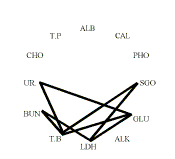
Heart Attack Outcome
Vadim I. Kvitash, M.D., Ph.D.
Department of General Internal Medicine, School of Medicine,
University of California at San Francisco
2299 Post Street Medical Building, Suite 306, San Francisco, California
94115
The purpose of this presentation is to demonstrate the practical
usefulness of Balascopy-based Systems Modeling for categorical
prediction of Heart Attack outcome in individual patients, which
is not currently possible through any other existing modalities.
Categorical prediction is defined as prognostic prediction of
outcome in individual patients using three mutually exclusive
categories: (A) Definitive Non-Fatal Outcome, (B) Definitive Fatal
Outcome, or (C) Uncertain Outcome. For the Systems Modeling, numerical
results of quantitative laboratory tests, routinely used in clinical
medicine for the evaluation of metabolic processes in the human
body, were obtained for initial data base. Twelve biochemical
variables [Albumin, Calcium, Phosphorus, SGOT(ASL), Glucose, Alkaline
Phosphotasia, LDH, Total Bilirubin, BUN, Uric Acid, Cholesterol,
Total Protein] which, by itself or in combinations, are useless
in predicting Heart Attack outcome are analyzed as a dynamic multi-dimensional
system with complex simultaneous qualitative, quantitative, relational
and directional changes. Information from initial data base was
processed for pattern cognition and pattern mining and the results
are graphically represented as biochemical meta-networks of multi-dimensional
systems spaces:
Non-Fatal Heart Attack Fatal
Heart Attack
Practical application of Balascopy-based Systems Modeling, for the first time, identifies previously unknown patterns of biochemical meta-networks for definitive categorical individual prediction of Heart Attack outcome and demonstrates the validity of the Systems Sciences approaches in the resolution of some current critical issues in medicine.
Keywords: Balascopy, Categorical Individual Prediction, Heart
Attack Outcome
[01 7]
Relons And Reloms: The Living Systems Relational Universals
Vadim I. Kvitash, M.D., Ph.D.
Department of General Internal Medicine, School of Medicine,
University of California at San Francisco
2299 Post Street Medical Building, Suite 306, San Francisco, California
94115
It is generally accepted that relationships are the most essential
features of Living Systems. However, "relationships"
are mostly used intuitively in their general sense without a precise
definition of what they are in a systems-specific meaning. In
the Balascopy-based General Systems Technology, binary relationship
among elements, parts, or sub-systems are precisely defined, computed
and subsequently mapped as multi-dimensional networks of Relons
and Reloms, where "n" and "m" stand for normal
and malfunctional.
Relons are defined as normal, functional, balanced or symmetrical
binary relationships which do not contribute to systems malfunction
or failure. They exist only in two different forms: (1) Normal
Relons and (2) Adaptive Relons.
Reloms are defined as abnormal, dysfunctional, unbalanced or asymmetrical
binary relationships which directly contribute to systems malfunction,
insufficiency, failure or death. They exist in five distinctive
forms: (1) Plain Disintegrated Reloms, (2) Plain Integrated Reloms,
(3) Plain Inverted Reloms, (4) Inverted Disintegrated Reloms and
(5) Inverted Integrated Reloms.
Relons/Reloms mapping was extensively tested and successfully
verified in Ischemic Heart Diseases, Cardiac Surgery, Pulmonary
Function Testing, Primary Immuno-Deficiency, Drug Allergy, HIV-related
diseases, Geriatrics, Immuno-Personology and helped to identify
previously unknown relational patterns in 66 diseases.
Balascopy-based General Systems Technology demonstrated heuristic,
explanatory and practical value in pattern cognition/recognition,
early diagnosis and categorical prediction of disease outcome,
identification of new sub-types of known diseases and discovery
of new clinical entities.
Keywords: Balascopy, Systems-Specific Features, Relons and Reloms
[01- 8]