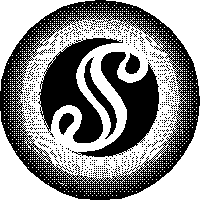
Directions: This gestalt figure forms a foreground/background gestalt figure. In this particular example, the idea is to focus on the black and then focus on the white. Notice how it mimicks the perceptual shift between parts and wholes. Notice in particular how it is either one or the other...
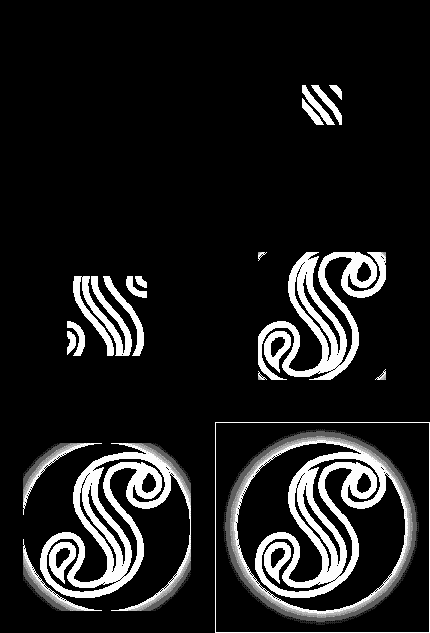
A similar gestalt figure is presented below at which demonstrates the dominance of one side over the other. We like to believe we have control over our perceptions, but these figures tell a different story, perhaps perspective is hard wired, or at least "trained" and that a shift actually requires concentrated effort.
An even more interesting phenomenon can be seen when the figures are viewed in different dimensions.
I visited a Synergetics site today, and happened across a page of stereo viewing techniques. http://www.wolfe.net/~setebos/springspace.html Seems by crossing one's eyes the right , a pair of identical pictures will merge into third three dimensional view. The trick is to overlay the right image over the left image. Once done, the brain will lock into this "3D" view. So I thought I would try it with our gestalt figure, the (s) Icon. . Cool. it works.
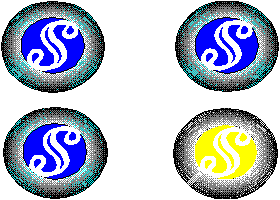
Out of curiousity more than anything else, I changed the colors in the middle expecting to find the blue and yellow merge into a green. They don't! What happened is that the blue dominated the yellow. Only by intense concentration was I able to bring the yellow on top, and then only for a moment. Reversing the colors did not seem to make a difference
Interestingly, if I focus on the upper two, both being blue, I notice out of the corner of my eye that the figure below is sometimes yellow. In fact I seem to be able to control which color I want to "notice" when I am not looking...
COMMENTS:
From: Newmanjb
(Association for the Scientific Study of Consciousness (ASSC)
To: ThomasM451
Dear Thomas,
...The effect you describe, ... is one Baars (1988) writes about as a defining characteristic of conscious perception: it strongly favors ONE perceptual gestalt. The examples he uses are ambiguous figures (the Necker cube or the famous Gestalt image of two faces/one goblet). The point is that we always perceive one or the other, not both simultaneously. What you describe fits that, although I would predict that you could also see the figure as all yellow at times, but as you note, not green.
Return to Kids Only Home page