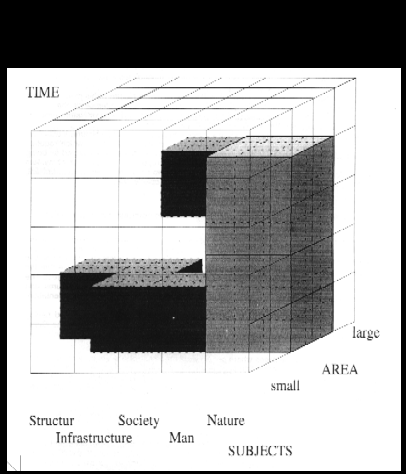
What Wholeness means to me?
How can it be best imparted to others?
Note should be made that children accept the concept easily and are ready for new conceptual or abstract understanding at about ten years of age. They focus conceptually beyond the immediate environment into abstract or virtual contexts, before the age of ten, their thing and think is to experience space, motion and time physically, logically, and conceptually. Before and after they can float in abstract realms (fantasia) and sometimes have good command of imagination (eidetic). Children liked the framework as a way to explain teachers and parents what is going on .
2.3 The word-scape or term- /theme-scape (semantic space) based on samples used in universal library organisation systems. One such scheme or global index is based on the square lambdoma, which is more suitable than spherical representations for this purpose, and is called the Information Coding and Classification (ICCa) by Ingetraut Dahlberg from the International Society for Knowledge Organisation (ISKO). The matrix of global subjects and general form concepts, and a depth dimension (specific facets or categories) is a semantic exploratory navigation space, based on harmonic principles, enabling storage without redundancies as well as access and permutations within underlying structures and patterns.
3. Navigation and Orientation in the three realms or conceptual spaces, including cut and paste operations allow overarching retrieval, correlations and configurations beyond narrow category definitions, semantic hurdles, and cultural stipulations.
Synthesis and Synopsis
Making use of the creative and integrative conceptualisation powers of humankind by using the visual and cognitive discrimination powers and imagine and construct relations in real and abstract ThinkScapes. As cognitive psychology and terminological and semantic studies prove to be deeply rooted perception and experience, and space is mathematically not reducible, it makes sense to integrate the genuine visual and senso-motorical powers of humankind for conceptual analysis and synthesis.
The Panorama invites thinking within, between and beyond boxes, words, knowledge, categories, and cultures. Thus it can trigger lateral and diagonal thinking within a unifying broader picture. It opens windows and doors and builds bridges between interest, items and issues, between a physical and virtual terra incognita. It is a simplistic, superficial configuration of Real- & Cyberspace modules. The self-generating mental mobility increases continually, as we experience that real and abstract worlds can be crossed by metaphoric s. Thus we can we map complex realities and avoid getting too perplexed.
Viewpoint generation and transportation are the native and cheapest form of therapy and healing. This broader concept of virtual mobility and mental locomotion is critical for the recent trend towards dematerialisation and sustainability. Using the eidetic and creative powers of humankind to plot mental maps and cognitive models might help chart our course in conceptual worlds, rationalise alternative paths of development , and help searching for wisdom and sensible, responsible action. We find in orientation, cognitive metaphoric concepts known to many traditions and teachings, a true treasure of humankind - why not get more conscious about the way our ideas move?
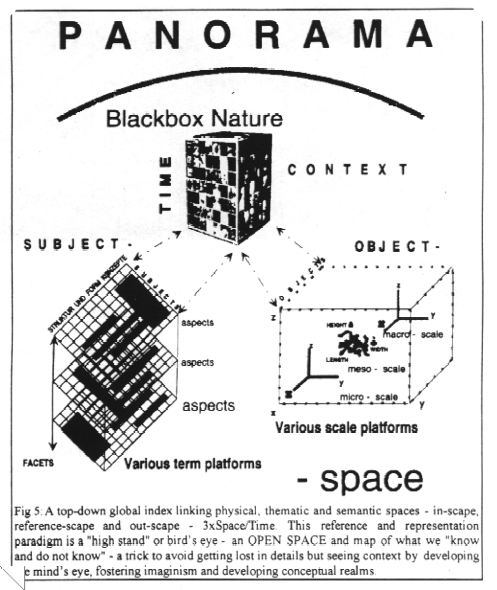
Providing a Topos for Topics or Issues, and engendering space, place and situation will bring more transparency, clarify positions and bring proportions and horizons of issues into sight . I can be done with the visual powers of the eye and the mind s eye and it is worth a try, any effort to fight resignation, and a mandate the futurist Robert Jungk urged to work with children when developing such concepts.
We can take the cross-category approach we need in ecology for harmonization and apply it for even wider complex and dynamic object-subject-time consciousness realms, but we should not forget that the scaffolding must not be confused with Nature itself. As Korbyski warned: the map is not the territory . As we create and perceive the world, we revolutionise consciousness, this telescopic and poly-sopic approach will make as more aware about what we see where and help us pan&zoom, cut&paste, focus, and oscillate between or sphere of interest, a floating process known from cognitive research.
Some critical questions remain: Can humankind ? accept and apply our common powers of visualising and conceptualising, and look for nested orientation which can be easily communicated? ? afford walls of segregation, reductionism, and sectarianism? ? avoid looking for broader visions, ? neglect fields such as eidetics ? accept co-existence of models, perspectives and metaphors? ? create enough time to learn to be more aware about hard and soft imaginative reasoning?
Summary
The Panorama is not meant to be an oversimplistic approach, it needs to be seen as a pragmatic and workable orthogonal design with the benefit of designing common grounds for developing common eyes. It can be understood as a configuartion of nested modules/models, as we are used to in our non-linear experience, language, and reasoning. The design is open as it allows to explore freely and individually to the necessary depth and detail but not in the sense of the hologram of Nature containing all possible interconnections and self-similarities. It is contrast to a single view fish-eye, a combination of bird s eye views, which help to maintain overview by looking at the whole or bigger picture . By providing global orientation we avoid getting lost in details or fixed in one aspect only. The PANORAMA can be seen as a layout for meaning and discourse mapping by providing optics for concepts and context, for physical and mental models.
The trick is to use modular open spaces which can be analytically and visually explored, referenced and remembered - they bring more transparency for informed decision, but it also has drawbacks, and can be misused as picures are more easily considered correct and real. The proposal might help to navigate, explore and filter also immaterial objects and focus on the quality and context of information.
Steps towards common, broader and integral views:
Let us take the design or map as a way to find be curious, play and try to find out what might be there and in that way change ourselves by generating viewpoints and training mental mobility. The next step is to look for the quality of what is there. It helps to float between and find again and again context, neighbourhood, the origin, and the level and scope. It is just one layout to store whatever we know or search for, accommodating coherence and chaos - complexity and perplexity - and allowing us to keep our store of knowledge in order.
There is strength always in and between both: diversity and isolation, analysis and synthesis, local and global, mythos and logos, chaos and coherence. As we sometimes need to exchange ideas and agree on objects, and subjects, terms, and issues, we are well advised to agree on what we are talking about, common platforms, references, and co-ordinates for understanding, the location and neighbourhood also within real or virtual scenes, material and conceptual worlds.
The proposal exploits the potential of concepts like: space and place, concept and context, and metaphors like: orientation, picture, and vision. We find such analogies and metaphoric expressions in many figurative contagious and poetic language, but in this case we want to go another step further, help to not only talk about common objects, but about common subjects and issues - The focus is on integrating different views and aspects, not to develop filters or brokers, to invite the idea of poly- or pan-scopic perception, to get used to look for factual, literal and metaphorical meaning, to look for similarities and differences and oscillate between positions, thereby establishing depth (to apply the stereo-scopic model or picture here). By mapping the Known, Unknown, and Unknowable we might find new ways, see with different eyes, and develop new kinds of composed consensual views and perspectives.
References by Area of interest
Heiner BENKING
Academic background: engineer, planner, studies ranging from geophysics to philosophy focus in engineering exams 1973 focus: modeling, geoecology and geomorphology, raster and matrices operations, computer graphics programming, later marketing and sales worldwide in all application areas mid-life education: organisation, law, marketing and business
Professional epochs:
TECHNICIAN & ENGINEER & ENGINEER ADVISOR
1969-76 technician and engineer
1977-81 facilities- town-, and state planning coordinator and expert for ministry in Saudi Arabia
COMPUTER GRAPHICS (CG) EXPERT MARKETIER
1980-81 applications consultant, marketing and sales management Europe for mother/father of interactive CG (Auto-trol founded 1964)
1972- work for mother/father of color raster CG (UNIRAS founded 1979) 1986- 87 focus on environmental edp, scientific visualization, market development
TECHNOLOGY, ORGANISATION, & PR, MARKET, RESEARCH, MANAGEMENT, INDUSTRY CONSULTANT
1981-93 pdv-Mamagement Consulting and EXPER CONSULT,
1989-92 Market & Technology Trends, Automation market research & Newsletters International Organizations, e.g. UNEP Harmonization Project
1993- Applied Knowledge Processing (FAW, Ulm) and International Projects
1995- Communication Coordinator and Editor, The Club of Budapest,
1995- Terminology Research, Infoterm, co-founder, multi-lingual applications
Computer Graphics
1985 WCGA-CAMP main theme and keynote: World Computer Graphic Association, Computer Applications for Management and Productivity - Computer Graphics for Management, Sales, Marketing, and Market Research
1986-87 IBM SEARS Oldest IBM User Conference Papers on Graphics; Lectures in IBM ESRI Executive Briefing Center Brussels on Scientific Computer Graphics; IBM UNIVERSITY AND RESEARCH Congress, Lectures and Exhibitions
Environmental Research and Management
1988 Moeglichkeiten und Grenzen der Datenpraesentation im Umweltbereich, Informatik Fachberichte 170, GI - Deutsche Gesellschaft f ue r Informatik, Symposium, Karlsruhe, Springer Verlag
1989 Large Scale Biomonitoring for Renaturation, 1. Intern. Geoecological & Geomorphological Conf., Frankfurt
1989 Umweltschutz mit Adlerblick, Die fliegende Lupe, Bild der Wissenschaft, No.6, dva, for Braun/Vieser.
1990/91 Information about Environmental Information: Discussion Paper and Proposals for the first UNEP-HEM International Expert Group meeting in combination with the feasibility studies and various proposals.
1991 Geo-/Object-Coding for Local Change Assessment, Planning, Execution, Accounting, and Research Demand Repeatability and Validity of Geotope/Biotope Information, GLOBAL CHANGE 89 Moscow Conference Volume, GeoJournal 20.2, 167-173, Kluwer Academic Publishers, Dordrecht/Boston/London
1990 GLOBAL CHANGE exhibition, contributions for AGF in German Chancellery, Bonn
1991 Harmonization of Environmental Measurement, GeoJournal 23.3 249-255, Kluwer
1991 LOCAL AND GLOBAL CHANGE exhibition Research and Co-ordination Tasks of International Organizations, geotechnica, Cologne
1990-92 Image poster for and about past present, futures and potentials of the Alfred-Wegener-Foundation - AWS an association of geo-scientific and resource, production and energy related unions, exhibitions & projects like the preparation of the geotechnica - the Marketplace of the Earth in cooperation with the President of the AWS, Prof. F. Strauch, Bonn-Muenster
1992 Access and Assimilatiand on: Pivotal Environmental Information Challenges, Linking, Archiving, and Exploiting Multi-Lingual Multi-Scale Environmental Information Repositories, Geojornal 26.3 323-334, Kluwer Academic Publishers
1992 Bridges and a Masterplan for Islands of Data in a Labyrinth of Economic Environmental Information, - The HEMIS Design Proposal as a Subset and Extention of Retrieval and Informa tion Management Systems, Workshop M and Systems Presentations, 13th ICSU-CODATA, Beijing
1992 Harmonization of Environmental Meta-Information with a Thesaurus-based multi-lingual and multi-medial Information System, ISY - ESSIS International Space Year Conference on Earth and Space Science Information Systems, Pasadena
Governance, Policy Assistance, and Decision Support
1978-81 Technical and Administrative Reports for Minitry Municipal and Rural Affairs and High Executive Commities in Saudi Arabia
1990 GLOBAL CHANGE exhibition on behalf of the WHITE HOUSE Conference on Global Change. Presenting the challenges to Science and Policy in the FEDERAL CHANCELLERY, Bonn. Beside contributions of text and graphics for some posters, a physical model, the BLACKBOX Nature was build to present scales, proportions, and consequnces in one exhibt with the objective to adress politicians, academia, industry, and primarily the public! - Proposal to built sub-model for climate research, communication and education.
1991-95 CONSULTATIVE - member of steering committee to develop mediation guidelines cookbook
1994 Proposing a Conceptual Superstructure - A Work Report and a Vision toexplore issue-scapes as virtual landscapes, FIG XX, Melbourne, this paper was a key-note on behalf of the Director Noel BROWN of UNEP in New York, to review the Callenges in Search for Policy with special emphasis on the AGENDA 21 and possible contributions of SCIENCE. The objectives to which the presented paper was to give a perspective, were to highlighted as an alternative path towards the Objectives and Challenges after the Earth Summit, or more to the point: ? establish common frames of reference, ? develop common understanding, ? common levels of co-operation and common strategies, ? mobilise best and brightest, ? harness capabilities, ? initiate more solid foundations for policies and strategies, gauge the human prospectus, .....
1995 Club of Rome report on capacity to govern : applied to Climate Issues, with Dror, Y.: UN- Climate Conference, March, Berlin, in combiantion with the climate summit paprers for the ASCE Academy for the Security and co-operation in Europe and exhibition of 15 Organisations in the International Corner .
1995 A Robust Path to Global Stability: Touch but Feasible, with: Brauer, G.W., Fliedner, T.M., Greiner, C., Malaska, P., Morath, K., Pestel, R., Radermacher, F.J.: Group IV: Futures and Economy, and: Scales, Horizons, Proportions, and Consequences in Perspective, Group III: Eco-Philsophy/Environmental Ethics, World Futures Studies Federation Conference Futures Beyond Poverty, Nairobi
1996 Tansparent and Visible Transcultural Discourse Mapping - Anschauliche transkulturelle Diskurse, Umweltschutz und Krisenmanagement, Deutsch-Japanische Akademische Burse, University Ulm Awareness, Environmental Mangement, and Knowledge Organisation
1990 INFORMATION ABOUT ENVIRONMENTAL INFORMATION, Preparation, Discussion Paper and Proposal for the first UNEP-HEM Intern.Expert Group Meeting, EARTHWATCH REPORT 1991, UNEP- HEM, Munich and Nairobi
1991 Harmonization of Environmental Measurement, with: Keune, H. et al. , GeoJournal, 23.3, KLUWER ACADEMIC PUBLISHERS
1992 Acess and Assimilation: Pivotal Environmental Information Challenges, Linking, Archiving, and Exploiting Multi-Lingual Multi-Scale Environmental Information Repositories, with Kampffmeyer, U. , GeoJournal 26.3, KLUWER, Bridges and a Masterplan for Islands of Data in a Labyrinth of Economic and Environmental Information, - The HEMIS Design Proposal as a Subset and Extention of Retrieval and Information Management Systems, Workshop M and Systems Presentations, 13th ICSU-CODATA, Beijing
Harmonization of Environmental Meta-Information with a Thesaurus-based multi-lingual and multi-medial Information System, with Kampffmeyer, U.: ISY - ESSIS, International Space Year (ISY) onference on Earth and SpaceScience Information Systems (ESSIS), Pasadena
1993 A CONCEPTUAL SUPERSTRUCTURE, with: Judge, A.J.N., UIA; Uhlir, P., NAS/NRC Washington
1994 Visual Access and Assimilation Strategies to prestructure Bodies of Environmental Knowledge: Proposals and Lessons Learned, with Brauer, G., International Society for Knowledge Organisation, Bratislava
1994 A Conceptual Superstructure of Knowledge - Quality and Content in Organisation, Management, and Awareness, with Brauer G.W., Grossmann W.D.: (1994) Information for Global Understanding of Environmental Problems: A proposal for visually displaying a knowledge meta-base, ICSU-CODATA Chambery
1996 CONCEPT and CONTEXT Mapping - Towards common frames of reference, In: Trialogues at the Edge of Terms and Pictures, Section 1 Terminology and Philosophy of Science (planned with: Budin, Galinski, Oeser), TKE 96 - Terminology and Knowledge Engineering, Association for Terminology and Knowledge Transfer, International Centre for Terminology (termnet) , TU Vienna, 26.- 28. August 1996. Conceptual topologies and macro-structures: Possible future contributions from the Exact and Fine Arts towards terminology and context mapping, Multilingual Information Society and Terminology Standardization, on the occation of 25th anniversary of INFOTERM and 60th anniversary of ISO/TC 37, Budapest August 24th 1996 Conceptual Meeting Spaces: A Presentation of Scales, Models, Functions, and Issues; In: General Systems Thinking, Intern. Society for Systems Sciences, 40th Anniv. Congress, Budapest, September 17.-20.,
1996 Concept and Context Mapping: Towards Common Frames of Reference, Seminar in Knowledge Organization: Towards the 21st Century organized by the Commitee on Classification for Knowledge Organization (FID/CR), 1. Contribution representing Germany in the session of the Ranganathan Award Celebrations, International Federation for Information and Documentation (FID), 48th Conference & Congress, Graz Media Communication, Session II workshop, Communication for Planetary Consciousness, Fifth International Dialogue on Transition to Global Society, Landegg Academy, University of Maryland, The Club of Budapest
Philosophy and Ethics
1993 Leitziel: Interdisziplinaere Umweltwissenschaft, Prinzip Verantwortung - Wege zu einer integralen Umweltwissenschaft; Symposium in memoriam Hans Jonas, with: Schwitte, J.: Evangelische Akademie Hofgeismar und Fachbereich Evangelische Theologie der Philipps Universitaet Marburg, Hofgeismar 1993
1995 Scales, Horizons, Proportions, and Consequences in Perspective, Group III: Eco Philsophy/Environmental Ethics, World Futures Studies Federation Conference, WFSF; Futures Beyond Poverty, Nairobi
1996 Nature as a Blackbox: Towards a Panorama of Understanding - A Broader Spectrum for Floating Between and Beyond What we Know and Miss , Research Notes in WORLD FUTURES, Vol. 47
1996 SPACES OF MEANING - Reflections on Wholeness, Interconnectedness, and Consciousness. First World Member s Meeting of THE CLUB OF BUDAPEST, to appear in INTUITIVO, VIEWSLETTER, and homepage, Budapest Education, Creativity, and Mental Mobility
1992 Our View of Life is too flat, workshop and poster, coverage in Finsih media and Knowledge Spiral Children Newsletter zur World Futures Studies Federation (WFSF), Turku 1994 The Hyperlink ECO-CUBE: Proposing a Knowledge Panorama for Clearinghouse Organisation & (Environmental) Education, Computer-based Environmental Education, IFIP - GI Hamburg
1994 Design Considerations for Spatial Metaphors - Reflections on Viewpoint Transportation Systems, with: - Judge, A.J.N.: acm- ECHT, Edinburgh - with focus on merging and morphing views and metaphors, http://iguwnext.tuwien.ac.at/~andreas/ECHT94.WS.Benking.html
1995 Kreatives Problemloesen durch Querdenken, ThueringenOlympiade Technik im Rahmen von Jugend forscht , Rede vor der Preisverleihung; Paedagogische Hochschule Erfurt/Muehlhausen
1996 Generation, Transportation and Composition of Viewpoints and Perspectives; In: Creativity and Cognition 2, Intersections between Art, Technology & Science, Loughborough College of Art and Design
1996 Mental Models, Metaphors, and the Mind s Eye - Orientation and Mapping in Spaces of Meaning, VISION Plus 2; SEHEN, FUEHLEN, VERSTEHEN:Kontroversielle Ansichten ueber Entwicklungen auf dem Gebiet der Kommunikation, IIID Internationales Institut fuer Informations Design.
1996 Schwarzenberg, 11-13. July 1996 Neue Horizonte und Orientierungen dank einer Architektur fuerDenkraeume. In: MENSCH - MASSE - MEDIEN, Interaktion oder Manipulation, IFG Ulm School of Design Foundation
1996 Be and Feel Part of Life and Nature, Invited Workshop for Children, Session I, Education for Planetary Consciousness, Fifth International Dialogue on Transition to Global Society, Landegg Academy
1996 A Paradigm-Shift? Orchestrating Representations Like Knowledge Trees and Knowledge Spaces, COUNCEIL de l EUROPE, Conference on a NEW SPACE FOR CULTURE AND SOCIETY - New Ideas in Science and Art, Prague Castle, Czech Republic, Nov. 19-23, 1996 http://pconf.terminal.cz