A TEST
FOR CONTRASTIVE ANALYSIS
Spotlight in the Theater or
Selective and Non-selective Consciousness;
as a Complementarity
in a Global Workspace
T. Mandel
Abstract.
Bernard Baars proposes an integrative concept of consciousness that marries
the conventional "spotlight" and "Theater" Metaphors
into a significant whole called "Global Workspace." This page
conducts an experiment which demonstrates the effects described above utilizing
a stereo figure. The results provide us with a qualitative difference between
conscious and unconscious vision, indicating that our seamless visual consciousness
is actually a fusion of conscious and unconscious, a global workspace of
the spotlight and the theater.
Part 1 Target Paper by Bernard Baars
from the abstract
Scientific metaphors have long provided heuristic tools for approaching
novel problems. Today, the neurobiology of consciousness and attention
is once again a central concern, presenting formidable conceptual and
empirical challenges. It therefore makes sense to try out the heuristic
tools that have worked before. Many current ideas fit the broad theme
of a theater metaphor. This idea can be worked out in detail, resulting
in testable hypotheses with clear relevance.
-----------------------------------------------------------------------
Metaphors and analogies have a long history in scientific thought. They
include the Rutherford planetary analogy for atomic structure, the
clockwork metaphor for the solar system, and Harvey's pump metaphor for
the heart. (1) Such heuristic metaphors are useful especially when the
sciences encounter a topic that has no clear precedent. In the case of
consciousness and attention neuroscience appears to confront un-
precedented problems once again.
A classical metaphor for consciousness
has been a "bright spot" cast by a spotlight on the stage of a
dark
theater, integrating multiple sensory inputs into a single conscious
experience, and then disseminating it to a vast unconscious audience.
Such a theater stage is called a "global workspace" in cognitive
theory. (2) It implies both convergence of input, and divergent dissem-
ination of the integrated content. In this century, features of the
theater metaphor have been suggested by neurobiologists from I.P.
Pavlov to Francis Crick. Indeed, nearly all current hypotheses about
consciousness and selective attention can be viewed as variants of this
fundamental idea. (2, 3) If that is true, its pros and cons may be
worth exploring.
PART 2 A test of Binocular rivalry and Global Workspace.Theory
Purpose of test: to show quantitative or qualitative differences between
selective and non-selective visual consciousness by means of contrastive
analysis, and to determine if these qualitative differences operate as a
complementarity whole in visual consciousness as predicted by GWT.
Procedure
Bring up http://www.isss.org/stereo.html
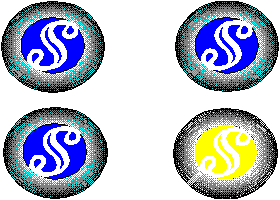
A pair of figures is presented. These figures are to visually superimposed
(as explained below) such that a 3D figure emerges. This is called "lock-in.
Once lock-in is achieved, the specified observations are made.
(1) scroll screen so only the first pair of identical figures can be seen
(2) Look at the figures but focus beyond them, on the horizon, so to speak.
The pair of figures will be doubled to four circles.
The object is to move the eyes so that the pair first become four figures
and then merge into three, The center merged figure will appear to be in
3D.
(3) Notice how the figures "lock in."
(4) Practice until you can focus and lock in easily. Observe.
5)Then scroll the screen up until only the lower figures are showing.
(6) Now try the whole process over again. It will be difficulat because the figures are different. Focus on the outer rings which are still the same. Try to achieve lock-in.
(7) When you do, notice which color comes up. Does one dominate? Is there a preference for only one? In my case the blue dominated, and try as I would, I couldn't make yellow come up on top for very long.
(8) Now scroll the screen down until all four figures are showing.
Lock in on the top pair of figures.
(10) Notice that you can almost see what the lower figures are doing in
the lower perifreral vision. In my case, they were dancing from one color
to the other. Quite unlike what they would do when I looked at them.To me,
the upper figures appear to be "selective" and the lower figures
appear to be non-selective.
Part 3 Discussion.This double twin experiment clearly shows us that visual consciousness is "selective on a background of nonselectivity" - the non-selectivity being, it is conjectured, our visual unconscious. Thus it appears that our so-called normal visual consciousness is not a single consciousness, but a complementary. Not at all unlike the complementarity of the photon, for example, which is spread out like a wave AND focused at a point like a particle. (This is why we stop at a red light while talking on the telephone, or why a carpenter can hammer at a chisel but look only at the point of the chisel even when moving the head of the chisel this and that way.)
Complementarity tells us that we cannot test both at the same time, that
if we test for a particle, we find a particle, and if we test for a wave,
we find a wave. Jack Hitchcock at http://www.newciv.org/ISSS_Primer/asem20jh.html
describes how these two aspects can be integrated such that they express
themselves as a whole "Our knowledge that it is light, a unity, or
electron, another unity, to which the opposites apply, emphasize a "both/
and". See notes.
IF consciousness is a complementary like complementarity, then we are already
experiencing our visual consciousness both selective and non-selective in
a smooth seamless whole.
REFLECTIONS
There are many instances when consciousness has taken on a dualistic expression
- the conscious and the unconscious, for one, that can be understood by
contrastive analysis. The intellect, the intuition, the illusion the real.
and in most cases there is, it seems, intitially anyhow, a contest between
the two, an emphasis on one or the other. A struggle between the Mind and
the Heart. Victory or defeat.
If these forms were interpreted (and acted on) as a complementary, a selective consciousness and a non-selevtive consciousness, but both at the same time, like what we see in front of us, it would no longer be a matter of one or the other, but, obvious, both. Just like our visual consciousness.
It would be interesting to determine the ramifications of such a paradigm. How many dualistic conceptual systems can be redrawn as complementaries?
CONCLUSIONS
In terms of Global Workspace, this experiment, by means of contrastive analysis,
illustrates the spotlight metaphor, or the selective consciousness, and
as a background, the theater metaphor, or the non-selective unconsciousness,
as a complementary whole, or GWT.
It is clear that the non-attentive theater component of our non-selective
visual unconsciousness is different from the attentive conscious component
as shown by the free dancing of colors compared to the rigid dominance of
the selective spotlight visual consciousness.
<
Tom Mandel
Notes:
Menas Kafatos. Robert Nadeau; The Conscious Universe; Part and Whole in
Modern Physical Theory" 1990, Springer-Verlag.
"Drawing extensively on Niel's Bohr's definition of the logical framework
of complementarity, which we reagrd as fundamental to understanding the
actual character of physical reality in a quantum mechanical universe, we
will advance and attempt to support the view that complementarity is the
most fundamental dynamic in our conscious constructions of reality in both
ordinary and mathematical language systems." pg 11
Ref:
T. Mandel. "A Test for Contrastive Analysis." http://isss.org/stereo.htm
T. Mandel. "Letter to the List: "Binocular Rilvary, Dec. 14, 1997 PSYCHE-L List.
Jack Hitchcock. "Complementarity infers the whole" http://www.newciv.org/ISSS_Primer/asem 20jh.html
T. Mandel. "Stereoscopic vision " http://www.newciv.org/ISSS_Primer/seminarm.html
Menas Kafatos. Robert Nadeau; "The Conscious Universe; Part and Whole in Modern Physical Theory" 1990, Springer-Verlag.
Ludwig von Bertalanffy, 1968. "General System Theory"
Popper & Eccles. "The Self and its Brain: And argument for interactionism." 1981 Springer International